
An escape room, but the whole room competes for one inheritance.
Blackwood's Last Trick is a puzzle game in the spirit of an escape room. It runs in the browser, with no app and no props: one phone per team is all you need. It takes about an hour, and you play it solo or in small teams of two to four, so people can put their heads together and argue about the answer.
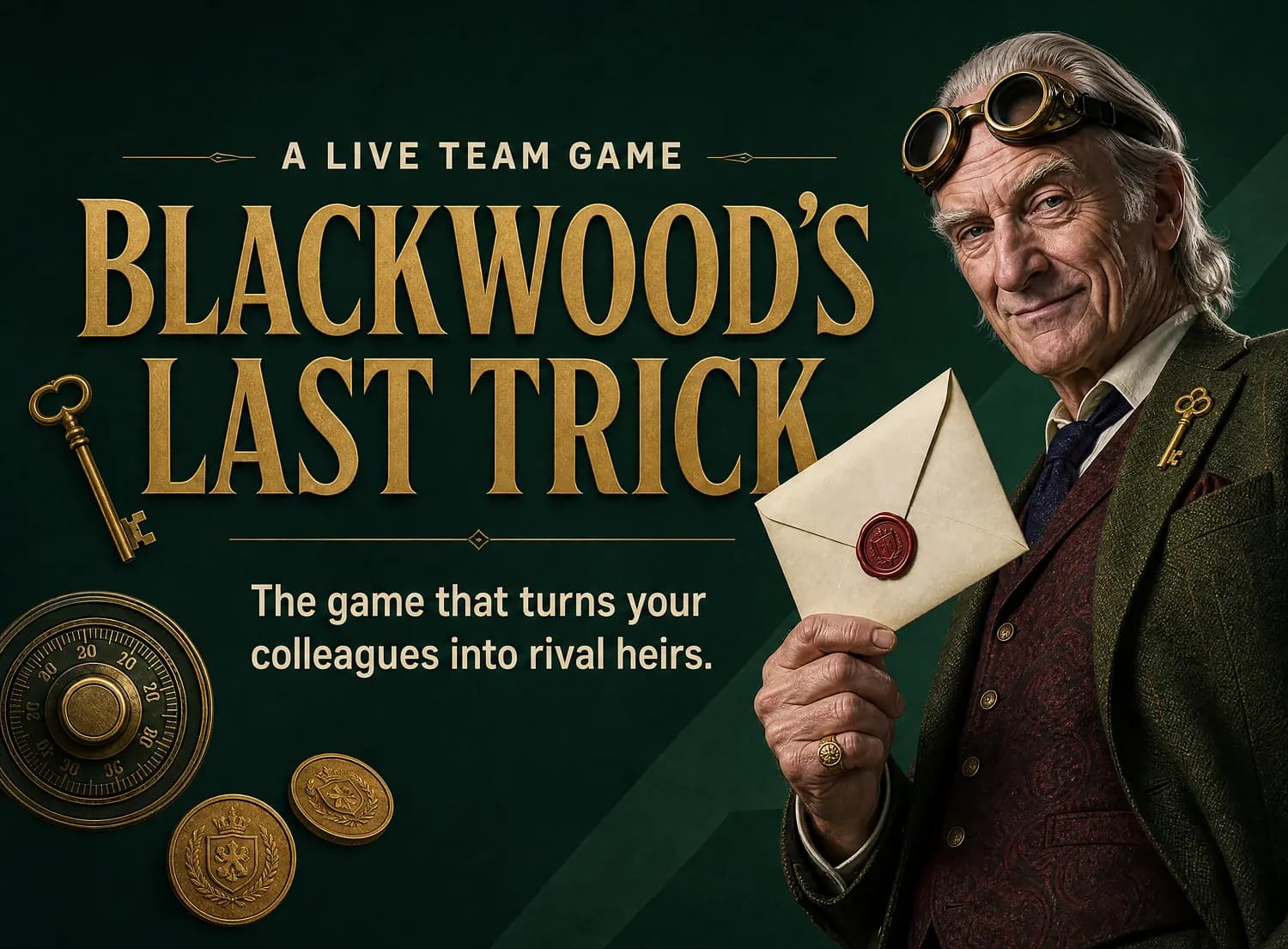
Arthur Blackwood, eccentric inventor and collector of odd things, has disappeared. He left a test for anyone who wants his fortune. The team that ends up richest inherits.
Search. Solve. Inherit.
Arthur hosts it himself
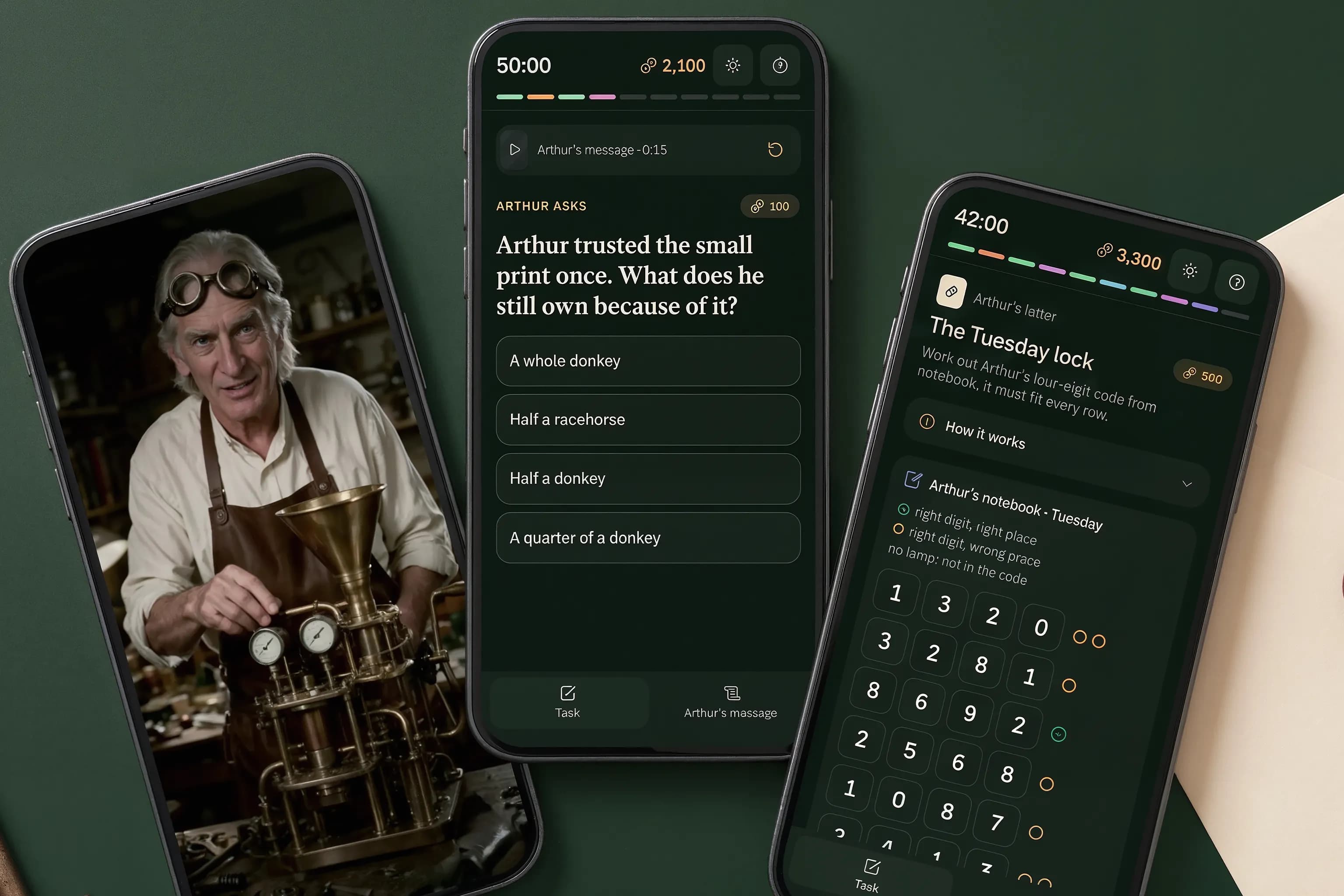
Arthur talks to the teams in short video messages, on the big screen and on the phones. He is vain, impatient and losing a running battle with his own chair. He also hides clues in his videos. Teams that pay attention save money. The rest pay for it.
It's a bit of interactive film, but the puzzles carry the game.
Who it's for
- Company events, seminars and offsites that want a full hour with a story, not a string of quick rounds.
- Escape-room operators who need to keep waiting groups busy, or want an extra hour to round out their programme.
- Families, parties, even a pub night. The game is ready to play as it ships: if you don't want to change anything, you don't have to.
- Groups who like to think together: puzzle fans, escape-room regulars, colleagues who argue about everything anyway.
It's a one-time game. The first time is properly tense; the second time you already know the answers. Book it for people who haven't played it.
How it plays
- Teams join with a link or QR code, one phone per team. Every team starts with 1000 crowns, and money is the only score.
- Ten tasks and four bonus games, in the same order for everyone, each team at its own pace. You hunt for things around you, crack codes, piece things together, and make decisions that win or lose money.
- After some of his videos, Arthur asks a quick question. Teams that were listening earn a little extra.
- About an hour, depending on how sharp your teams are. Then comes Arthur's reveal on the big screen: a drumroll, a spotlight, and one team inherits.
Nobody gets stuck
Every task has a way forward, and every way forward has a price. The fun stays in solving, not in staring at a locked screen.
- In a search, the objects range from rare to something every team always has with them. The rare one pays best. The one you can always find costs you.
- In a puzzle, after the first try you can buy help one step at a time: a nudge, then a bigger one, then very nearly the answer. The last step always gets you through.
- In a decision, you can pay for advice before you commit.
- You can buy help even when your money runs out. Debt is allowed, and the teams that end up there get a title for it at the end.
- A wrong answer costs only time.
Buying all the help for a task costs more than the task pays, so trying first is always worth it. And a slow team still finishes the story together with everyone else.
Built for the organiser
Everything here is optional. Open the game, press start, and it plays as it ships. If you want to tune it:
- Pick the language. Eight ship with the game, or add your own.
- Pick the search objects. Use the ready lists for indoors or outdoors, or describe your venue and let the AI suggest objects that are actually there. Walk around, tick, save.
- Choose who checks the photos. The AI does it by default, or a person at a tech desk can.
- Start the game. Change the play time before or during the game, and pause everyone at once if the coffee arrives.
- Start Arthur's reveal when the play time is up.
You get a short answer sheet with every answer, where its clue comes from, and what to tell a stuck team. A big screen works best; without one, teams watch Arthur on their phones.
Languages
The game is puzzle-based and played mainly in English, because Arthur speaks English. It ships in English, Spanish, French, Portuguese, Estonian, German, Italian and Finnish, and in every language but English his videos carry subtitles.
The translations are automatic, so play it through once in your language and reword any line you don't like, right in the host settings. If your language isn't on the list, you can add your own.
What it does to a room
Two people bent over one phone, arguing about a digit. Someone running back from across the room with a find. The quiet one who cracks the code. Nobody waits for anyone, and everybody meets again at the end in front of the big screen to see who inherits. Arthur does the talking, so the host doesn't have to.
In the GFC library it's the full hour with a story. For something shorter and louder, look at Traps or True or False.